



Sports Value has been studying Brazilian football data for decades, and we are living an important moment with the debate on Financial Fair Play in Brazil.
In 2024 we launched the first version of the Financial Fair Play application but based on 2022 and 2023 data. The 2023 financial exercise was heavily impacted by extraordinary resources paid by Liga Forte União (LFU).
In Sports Value’s analysis, LFU funds are not recorded as operating revenues of clubs and SAFs.
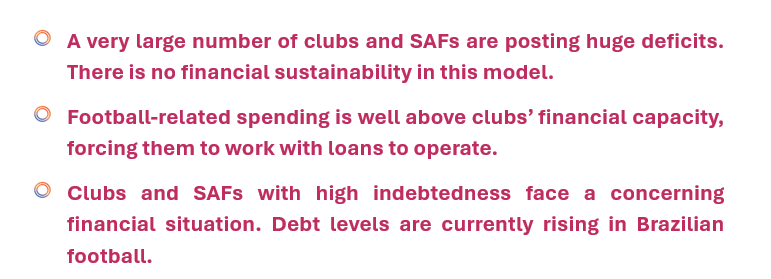
This updated 2025 version considers 2024 data and previous years. In 2024, Brazilian clubs posted combined losses of US$ -300 million.

Our view is that the best regulatory mechanism applies a cross-sectional analysis of financial data and capital flows. From clubs and enterprises (SAF- Sociedade Anônima do Futebol).
Financial Fair Play in Europe suffered many “dribbles,” such as inflated sponsorships from companies tied to billionaire-owned clubs.
Brazil can learn from the strengths and weaknesses of different global models and establish a modern regulation that targets the healthy growth of the industry.
For Sports Value, the ideal Financial Fair Play model is transversal, analyzing different financial data and ratios.
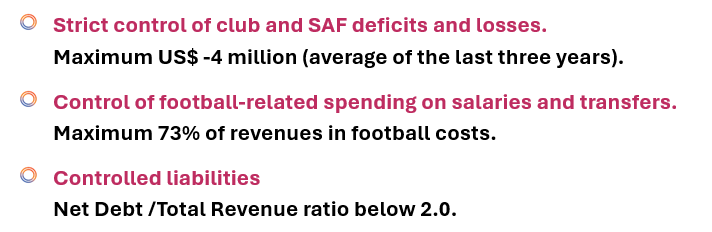
1. Deficits – Applying the analysis to Brazil with 2024, 2023, and 2022 data.
Analyzing the average net results of clubs over the last three years, many are above the US$ -4 million annual limit set by Sports Value.
Net Profits / Losses – Average of the last 3 years – 2022/2023/2024 – US$ million
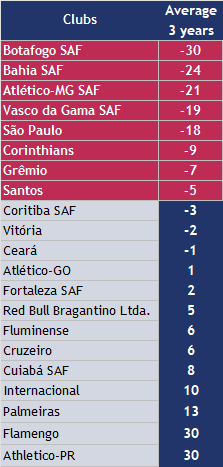
Botafogo SAF, Bahia SAF, Atlético-MG SAF, São Paulo, Vasco da Gama SAF, Corinthians, Grêmio and Santos, show average 3-year deficits above US$ -4 million.
Net Profits / Losses – Accumulated over the last 3 years – 2022/2023/2024 – US$ million
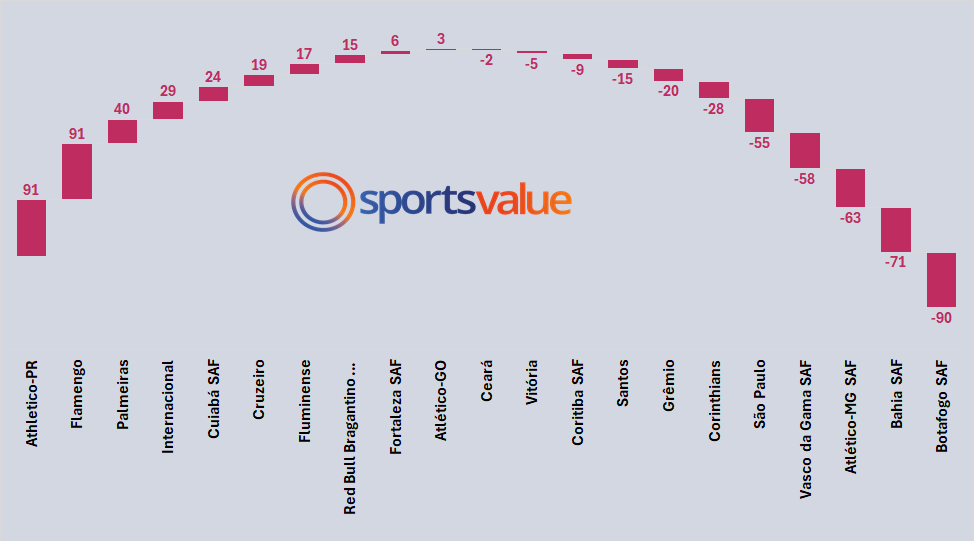
The main SAFs accumulated US$ 342 million in losses over three years due to lack of regulation.
Botafogo SAF
Accumulated US$ -90 million in losses over three years.
Bahia SAF
Accumulated US$ -71 million in losses over three years.
Atlético-MG SAF
Accumulated US$ -63 million in losses over three years.
Vasco da Gama SAF
Accumulated US$ -58 million in losses over three years.
Clubs also posted huge deficits:
São Paulo
Accumulated US$ -55 million in losses over three years.
Corinthians
Accumulated US$ -28 million in losses over three years.
Grêmio
Accumulated US$ -20 million in losses over three years.
Santos
Accumulated US$ -15 million in losses over three years.
2. Control of football-related expenses
Another key aspect of Financial Fair Play, after losses, is the analysis of football costs as a share of total revenue.
For Sports Value, the ratio of 73% of football expenses over revenues can be considered a safe limit. Less-indebted clubs without excessive social club costs might reach close to 80%, but these are rare.
Very high ratios indicate unbalanced management and financial risk to the Football Industry.

Which Brazilian clubs show high Football Costs/ Total Revenue ratios?
Sports Value’s analysis of 2024 club financial statements shows that on average Brazil’s Top 20 clubs had a Football Cost/Total Revenue ratio of 81%. A large part of Brazilian football is above 73%.
Only Cuiabá SAF, Athletico-PR, Corinthians, Palmeiras, and Santos had ratios at or below 73%. And even with this ratio, some still posted heavy losses, such as Corinthians and Santos.
Football Cost/Total Revenue ratio – In %
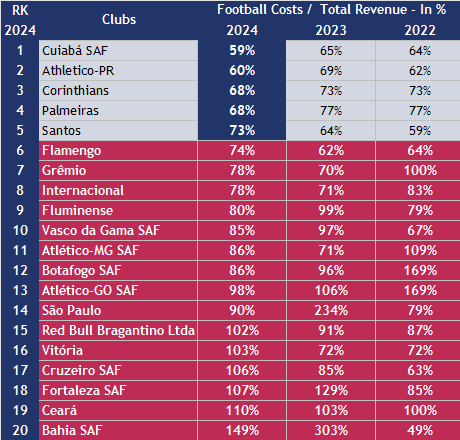
Bahia SAF, Ceará, Fortaleza SAF, Cruzeiro SAF, Vitória, and Red Bull Bragantino are above 100%. (Red Bull has high training center costs, booked as football expenses.)
São Paulo, Atlético-GO SAF, Botafogo SAF, Atlético-MG SAF, and Vasco da Gama SAF had ratios above 80%.
3. Controlled Liabilities
Finally, a third important element for Financial Fair Play is strict control of clubs’ net indebtedness.
Sports Value´s Calculation of net debt:
Net Debt = Total Liabilities – Current Assets – Realizable Assets
Clubs’ financial history proves that this is the best way to analyze debt levels in Brazil, since clubs often use player transfer revenues to inflate EBITDA (Earnings Before Interest, Taxes, Depreciation, and Amortization).
In reality, in Brazil, future cash flow depends on extraordinary revenues, ( in general the transfers). EBITDA should only include recurring revenues, excluding transfers. Thus, the Net Debt/Revenue ratio is the clearest indicator of clubs’ financial health.
For Sports Value, under a Financial Fair Play regulation, the ratio should not exceed 2.0. The 2024 average of Brazil’s Top 20 clubs was 1.23.
Many clubs boosted revenues with prizes and player sales, inflating total revenue. In 2025, radical changes in the ratio may occur.
Net Debt / Total Revenue ratio
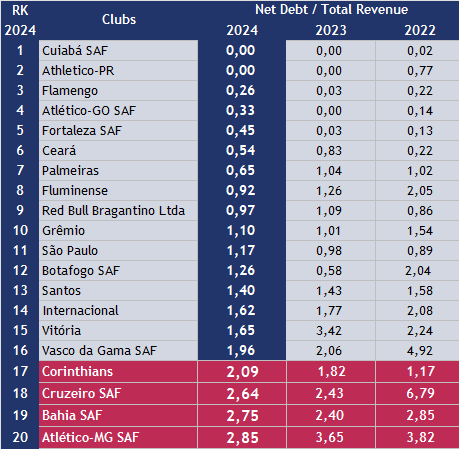
Atlético-MG SAF, Bahia SAF, Cruzeiro SAF, and Corinthians are above 2.0.
Vasco da Gama SAF, Vitória, Internacional, Santos, and Botafogo SAF may see an increase in 2025.
Conclusions